 Weather: 614-526-6500

Little League's regular-season pitching limits are tied to league age and pitch count. For players 14 and under, 1–20 pitches require no rest days and 66 or more require four. The last-batter exception, catching restrictions, and consecutive-day rules can alter the next eligible outing; other baseball organizations use different policies.
Which youth baseball pitching rules apply to your game?
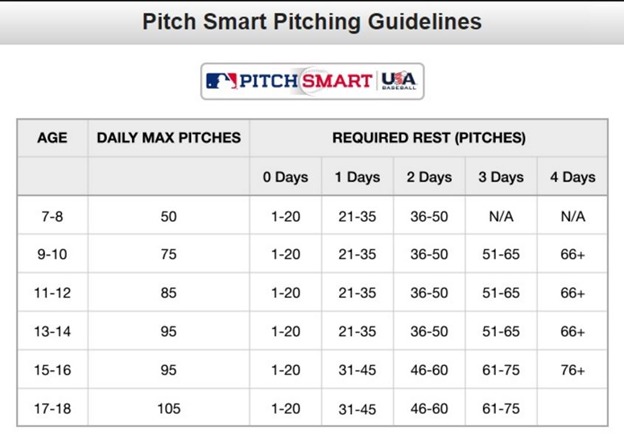
The tables explain Regulation VI for regular-season players ages 6–16.
MLB and USA Baseball publish separate Pitch Smart guidelines for ages 7 to 22. Those are workload and arm-health recommendations. For Little League regular-season games, Regulation VI is the rule.
USSSA and PONY write their own rules. USSSA's national baseball bylaws, revised March 25, 2026, set innings-and-outs limits for standard events and allow specified pitch-count provisions at approved major events. A PONY explanatory page was last modified in February 2022. Each event's rulebook sets its pitching policy.
Check three things first: the governing organization, the baseball division, and whether the game is regular season or tournament play. Softball and Challenger formats have different regulations.
What is the Little League pitch-count limit by age?
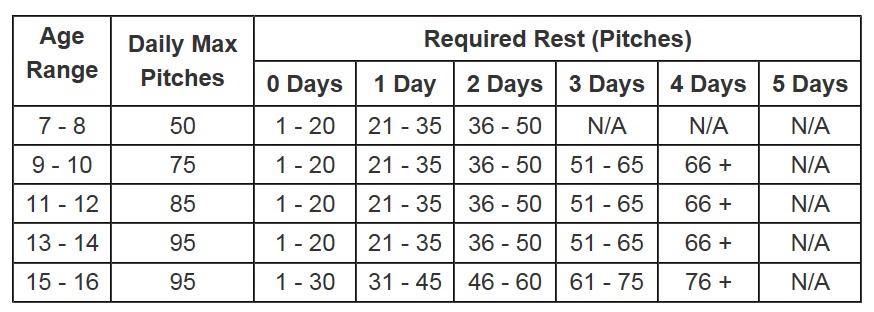
| League age | Maximum game pitches per day |
|---|---|
| 6 to 8 | 50 |
| 9 to 10 | 75 |
| 11 to 12 | 85 |
| 13 to 16 | 95 |
A league-age 10 pitcher has a 75-pitch daily maximum. The 85-pitch limit covers league ages 11 and 12, but a league-age 12 player can't pitch in the Minor League Division under the same regulation.
League age is Little League's eligibility label, and it can differ from the child's birthday age on game day. For details on Little League, high school baseball, and MLB, see pitch counts, required rest and the MLB pitch timer.
A pitcher who reaches the maximum while facing a batter can finish that batter but can't start another. Every pitch thrown still counts.
How many calendar days of pitching rest are required?
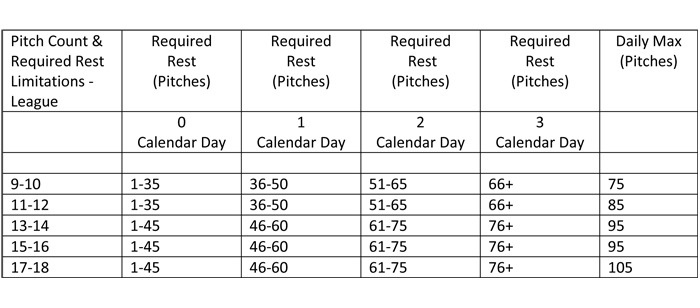
Rest days depend on league age and how many pitches the player threw. Count full days off between outings. The game day itself doesn't count, so the first rest day is the next calendar date.
| Complete rest days | Ages 14 and under | Ages 15 to 16 |
|---|---|---|
| 0 | 1 to 20 pitches | 1 to 30 pitches |
| 1 | 21 to 35 pitches | 31 to 45 pitches |
| 2 | 36 to 50 pitches | 46 to 60 pitches |
| 3 | 51 to 65 pitches | 61 to 75 pitches |
| 4 | 66 or more pitches | 76 or more pitches |
These ranges don't raise the age-based daily maximum. A 12-year-old, for example, is still capped at 85 pitches.
Three Monday outings with different results
Take three Monday outings: two by a league-age 12 pitcher and one by a league-age 15 pitcher. No last-batter exception applies to any of them.
- 37 pitches: Two full days off, Tuesday and Wednesday. Thursday is the earliest return.
- 55 pitches: Three full days, Tuesday through Thursday. Friday is the earliest return.
- League-age 15 pitcher, 50 pitches: The older group's 46 to 60 range requires two full days. Thursday is the earliest return.
A zero-day rest category doesn't override the consecutive-day, doubleheader or position rules. Suspended games and regulation tie games can also bring earlier pitching records into the count.
How does the last-batter threshold exception work?
When a pitcher qualifies for Little League's last-batter exception, the first pitch thrown to that batter sets the rest bracket. The game total stays at the number of pitches actually delivered.
Take a league-age 12 pitcher who has thrown 48 pitches before facing the last batter:
- Before that batter, the actual count is 48.
- The first pitch to that batter is pitch No. 49.
- The at-bat ends with 53 actual game pitches.
If the exception applies, No. 49 falls in the 36 to 50 range, so ages 14 and under need two full rest days. The game total stays at 53. Had the pitcher already thrown 50 before a new batter, the first pitch would be No. 51, in the three-day range.
The exception ends when the batter reaches base, is retired, the third out ends the half-inning or game, or the pitcher is removed.
A real dispute: 48 pitches or 51?
A Reddit poster asked who was right when a coach and a family member disagreed over what controls rest after a final at-bat:
My Dad and a coach had a disagreement about major league 11-12 u pitching rules it says if u pitch over 51 pitches you must have 3 days rest. Will are pitcher started the at bat with 48 pitches and finish the at bat with 51 to get the 3rd out. Now my dad told him he should have pulled him early so he could have pitched Thursday but the coach said his total pitch count will only be 48 cause that what he started the at bat with. Who is right?

That pitcher started the at-bat at 48, so the first pitch was No. 49. If the exception applies, No. 49 sets the rest bracket, and all 51 pitches stay in the game record.
Can a player pitch on consecutive days or in two games?
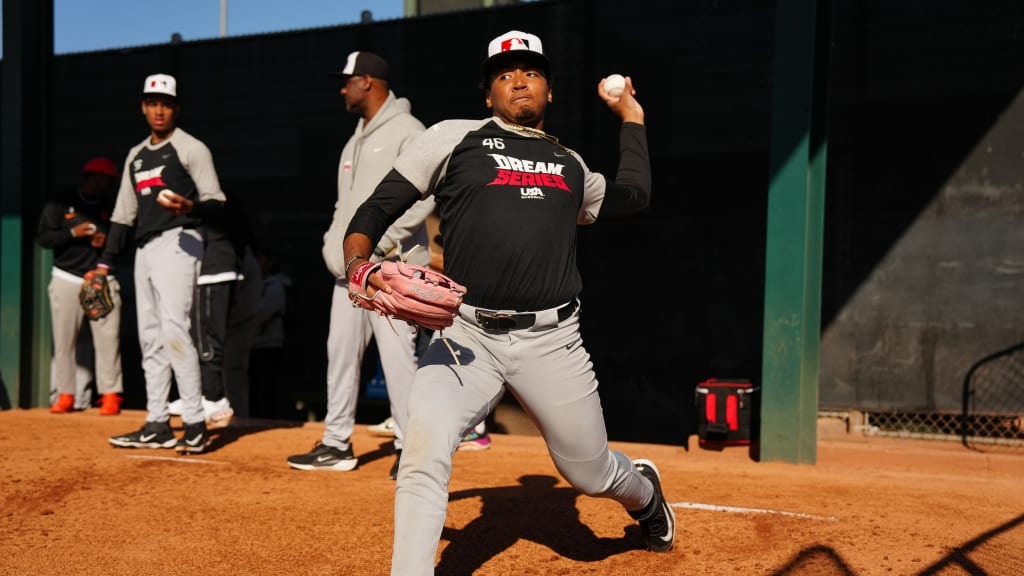
Little League bans pitching on three consecutive days, even when the first two outings are short enough to need zero rest days.
For a pitcher age 14 or younger, 15 pitches on Monday and 16 on Tuesday don't each trigger a rest day. Pitching on Wednesday is still prohibited under the three-consecutive-days rule.
Same-day games work differently:
- Minor, Majors and Intermediate (50/70): A player can't pitch in two games on the same calendar day.
- Junior and Senior: A player may pitch in two games in one day if the first game's count is no more than 30. A pitcher who reaches 30 while facing a batter can finish that batter and keep second-game eligibility, as long as he or she leaves the mound before delivering a pitch to another batter. The combined daily maximum is 95 pitches. A league-age 12 player in Junior or Senior can't pitch in two games on the same day.
- Return to the mound: A player who leaves the pitching position can't return to it in that game. The exception is the Intermediate, Junior and Senior divisions, which allow a limited return after the player plays another defensive position under Regulation VI's conditions.
Can a pitcher also play catcher?
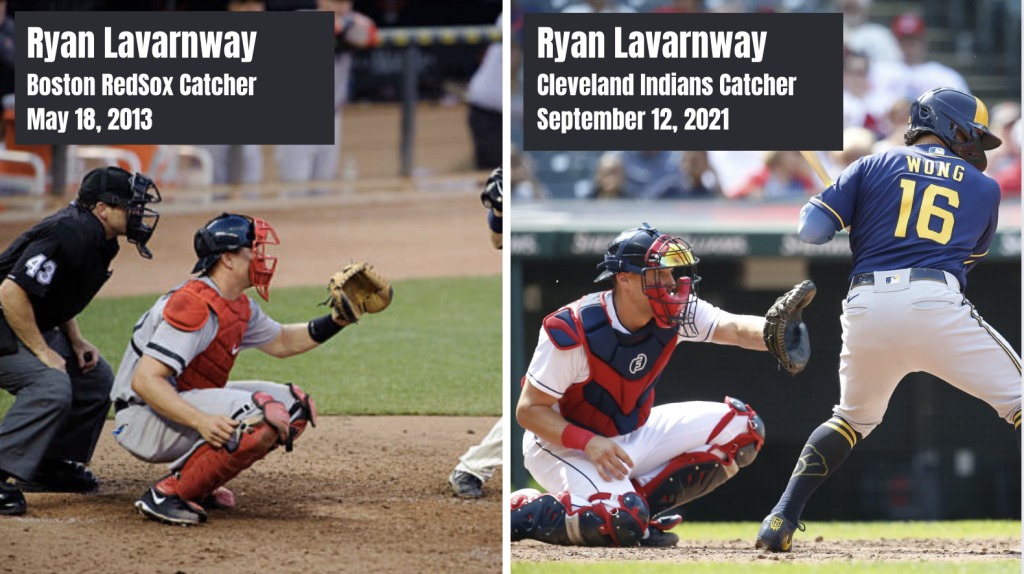
Little League restricts moves between pitcher and catcher in both directions.
| Player's sequence | Rule consequence |
|---|---|
| Catches four or more innings, then would pitch | Can't pitch that calendar day |
| Catches at most three innings, then pitches 21 or more at age 14 or younger | Can't return to catcher, unless the pitcher crosses the 20-pitch mark mid-at-bat and the exception applies |
| Catches at most three innings, then pitches 31 or more at ages 15 to 16 | Can't return to catcher, unless the pitcher crosses the 30-pitch mark mid-at-bat and the exception applies |
| Pitches 41 or more, then would catch | Can't catch that day, unless the pitcher crosses the 40-pitch mark mid-at-bat and the exception applies |
Receiving one live pitch in the fourth inning counts as catching in that inning. A player who caught a pitch in each of four innings can't take the mound later that day, even without completing the fourth inning.
For a player who caught at most three innings before pitching, the mark is 20 pitches at ages 14 and under and 30 pitches at ages 15 to 16. A pitcher who starts on the mound faces a 40-pitch mark before moving to catcher. In all three cases, a pitcher who reaches the mark while facing a batter can finish that batter and make the move, provided no pitch goes to the next batter. A league-age 12 player who caught two innings and then threw 23 pitches can return to catcher only if that exception applies. It doesn't change the four-inning rule for a catcher who wants to pitch.
Catching doesn't add game pitches to the Regulation VI count. Not every Little League rest rule bars catching on a required day off from pitching.
How should families track pitch counts across rec and travel baseball?
A player who pitches for more than one team needs one combined record, because a single league's scorebook can miss outings. Pitch Smart recommends monitoring pitching across teams and organizations throughout the year.
One r/LittleLeague poster asked how to handle recreation games on either side of a travel game:
How do you track pitch counts that include travel ball? We always prioritize safety of our players but we can't track pitch counts for travel games to apply those to our LL rule set. How do other leagues handle this? We have some players playing rec Saturday and Monday games with a travel game on Sunday.
What to write down for each game
Each entry should hold the game date, organization and division, actual pitches, the starting number for the final batter if an exception is claimed, catcher innings, other appearances, who recorded it, and any reported discomfort. Log practices and throwing lessons separately from official game pitches.
A scorekeeping app can combine the records. The upcoming competition's rulebook decides eligibility, and the family's chronological log shows the workload built up across teams.
Parents of younger players can read which safety and inclusive-play questions matter before joining.
Is a pitcher safe to throw when the chart says they're eligible?
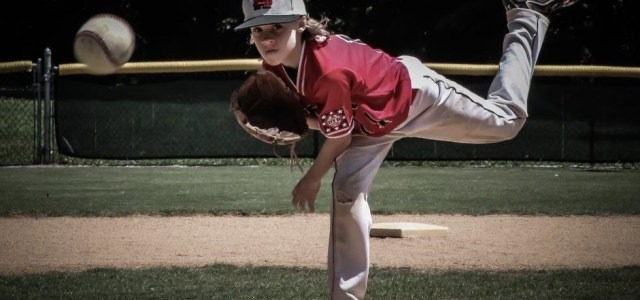
Finishing the rest interval doesn't make a player medically ready. The American Academy of Pediatrics explains in its Little League elbow guidance that repeated throwing stresses a young player's developing elbow, including throwing outside a mound appearance.
Arm pain changes the decision: Stop painful pitching or throwing and have a health professional evaluate it.
In a ten-year prospective study published in 2011, Fleisig and colleagues followed 481 pitchers ages 9 to 14.
About 5% met the study's definition of a serious throwing injury. Pitchers who threw more than 100 innings in at least one year had 3.5 times the relative risk of serious injury (95% confidence interval 1.16 to 10.44).

A separate cross-sectional study of 754 youth pitchers examined how risk-prone throwing activity relates to arm pain. Both studies are observational: they identify associations without establishing the cause of an individual injury.
Official pitch counts are only part of a player's throwing workload. Bullpens, catching, lessons, and practice may continue even after two prescribed rest days, and a player may still report elbow pain. Coaches and parents need to know when to modify a drill, stop play, or escalate a concern.
What should you confirm before the next pitching appearance?

Before the next outing, reconcile the player's pitching history with the official count sheet and the manager and recorder. Regulation VI makes the manager responsible for removing a pitcher. The earliest Little League regular-season return date follows the age-based rest calculation and any catcher, doubleheader, or consecutive-day restriction.